

Cart
0
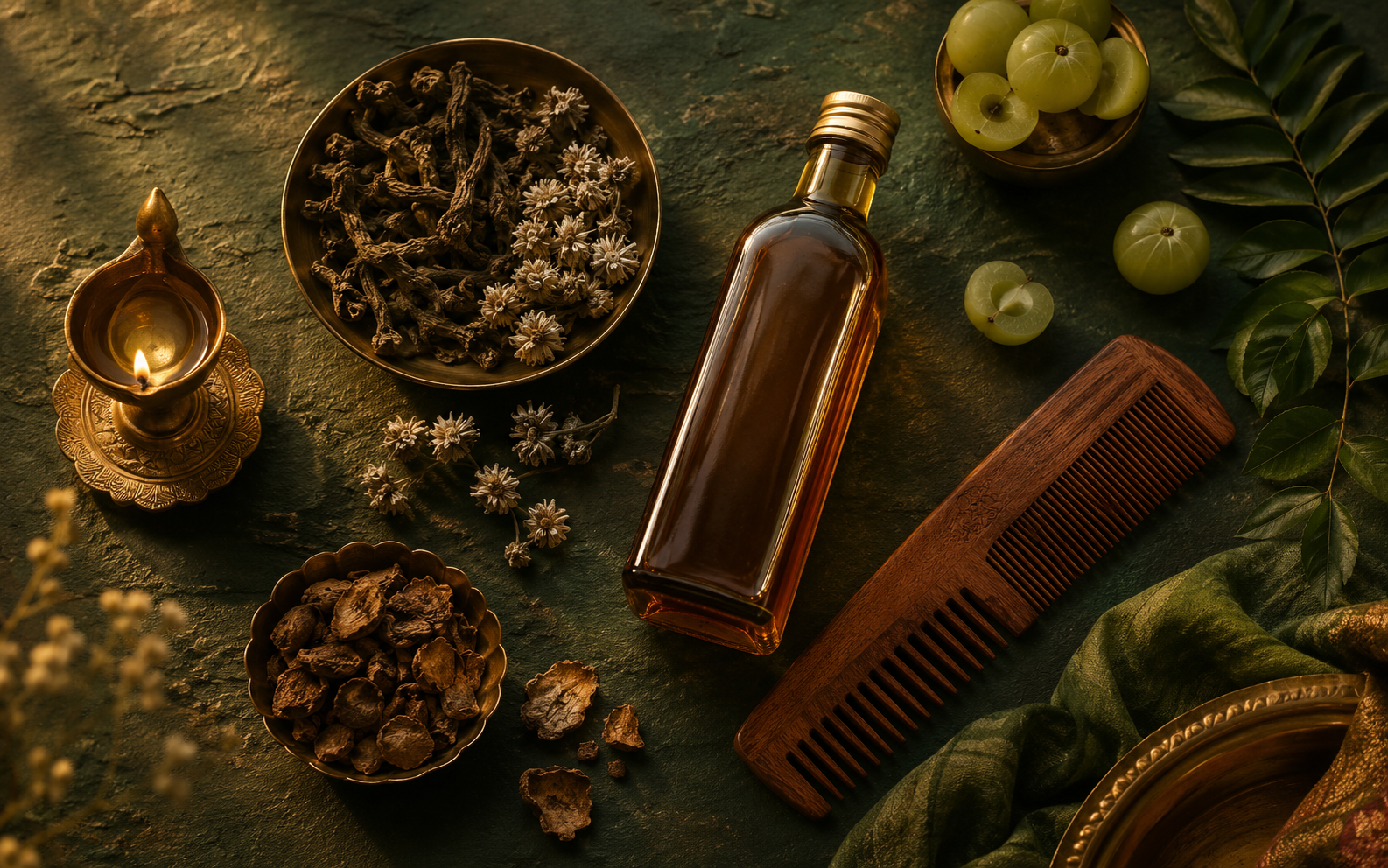
Introduction: The One Ritual That Changed Everything
There is a ritual that has been passed down through Indian households for thousands of years. A grandmother warming oil in her palm. The quiet of a Sunday morning. Fingertips working through hair, slowly, intentionally. No rush.
It is called Champi, the Ayurvedic hair oiling ritual, and for most of us, somewhere along the way, we stopped doing it. We got busy. We switched to dry shampoo and leave-in conditioners and twelve-step routines that promised everything but delivered very little.
And then our hair started to suffer.
If you are dealing with hair fall, thinning, breakage, a dry and itchy scalp, or hair that simply refuses to grow the way it used to, the answer may be simpler than you think. Not a new chemical treatment. Not a salon procedure. Just the right oils, the right herbs, and the right technique, applied consistently.
This guide covers everything you need to know about Ayurvedic hair oiling: the science behind why it works, which herbs and oils actually do what they claim, how to oil your hair correctly (most people are doing it wrong), and how to build a routine that fits your modern life. Whether you are a complete beginner or someone who has been oiling for years but not seeing results, there is something here for you.
Part 1: Why Hair Oiling Actually Works, The Science You Were Never Told
Hair oiling is not folk medicine. There is real, documented science behind why it produces results.
What Happens to Your Hair Without Oil
Your scalp produces its own natural oil called sebum, secreted by sebaceous glands attached to each hair follicle. Sebum is your hair's first line of defence. It moisturises the scalp, protects the hair shaft, maintains the scalp's pH balance, and keeps fungal and bacterial overgrowth in check.
Modern life is systematically stripping it away. Sulphate-heavy shampoos (which are essentially industrial degreasers diluted for consumer use), hard water, pollution, heat styling, and overwashing together create a chronically dry, inflamed scalp environment. When the scalp is inflamed, hair follicles suffer. When follicles are starved of nourishment, the hair growth cycle shortens. Hair spends less time in the anagen (growth) phase and more time in telogen (resting/shedding). The result is exactly what you see: more hair on your pillow, less on your head.
How Oil Reverses the Damage
When you apply the right oil to your scalp and hair, several things happen simultaneously.
Certain oils, particularly coconut oil, have a molecular weight small enough to penetrate the hair shaft. A landmark study published in the Journal of Cosmetic Science found that coconut oil, unlike mineral oil or sunflower oil, was able to reduce protein loss from hair both before and after washing. This is significant because protein loss is the primary cause of structural weakening, frizz, and breakage.
At the scalp level, plant-based oils provide a protective film that reduces trans-epidermal water loss (the evaporation of moisture from the scalp surface). They also deliver fat-soluble phytochemicals, the bioactive compounds in herbs like Bhringraj, Amla, and Brahmi, directly to the follicular environment.
Scalp massage performed during oiling, even briefly, has been shown in a 2016 study published in ePlasty to increase hair thickness over 24 weeks. The mechanism is mechanical stimulation: the pressure and movement of a massage stretches dermal papilla cells (the cells at the base of each follicle responsible for hair growth), which can upregulate the expression of hair-cycle related genes.
In short, oil is not just a coating. It is a delivery vehicle for the herbal actives your follicles need, combined with a mechanical treatment that stimulates growth at the cellular level.
Part 2: The Holy Trinity of Ayurvedic Hair Herbs
Ayurveda has a vast pharmacopoeia, hundreds of herbs used across thousands of years of clinical observation. But for hair specifically, there are three that appear in virtually every classical formulation and now have significant modern research to back them up.
Bhringraj: The Emperor of Hair Herbs
Eclipta prostrata, known in Sanskrit as Bhringraj (literally "king of hair"), is considered the single most important herb in Ayurvedic trichology. Classical texts like the Charaka Samhita and Sushruta Samhita describe it as kesharanjana, that which promotes hair growth and darkens hair.
Modern research has identified why. Bhringraj contains several bioactive compounds, including wedelolactone, ecliptasaponins, and phytosterols. Studies have shown that Bhringraj extract can inhibit 5-alpha reductase, the enzyme that converts testosterone into DHT (dihydrotestosterone), the primary hormonal driver of androgenetic hair loss in both men and women. By reducing DHT levels at the follicle, Bhringraj helps interrupt the miniaturisation process that causes thinning.
A study published in the Archives of Dermatological Research compared Bhringraj extract to minoxidil (the active ingredient in Rogaine) in a rodent model and found Bhringraj to be equally effective at stimulating hair follicle activity, with none of the side effects associated with pharmaceutical treatments.
Vanyam's Hair Revival Oil contains 200mg of Bhringraj per serving, a therapeutically meaningful dose, not a token inclusion.
Amla: Nature's Most Potent Antioxidant for Hair
Phyllanthus emblica, or Indian Gooseberry (Amla), is one of the richest natural sources of Vitamin C on the planet, containing up to 20 times more ascorbic acid than an orange. For hair, this matters enormously.
Vitamin C is essential for collagen synthesis, and collagen is a structural component of the hair follicle. Without adequate Vitamin C, the follicle wall weakens, and hair becomes prone to breakage at the root. Amla also contains tannins, gallic acid, and ellagic acid, powerful antioxidants that protect hair follicles from oxidative stress caused by UV radiation, pollution, and free radicals.
There is also strong evidence that Amla inhibits the tyrosinase enzyme involved in melanin production in ways that help prevent premature greying. For anyone noticing grey hairs appearing earlier than expected, regular Amla application is one of the most evidence-backed interventions available.
In Vanyam's formulations, Amla appears in both the Hair Revival Oil and the Restorative Hair Serum, working topically and systemically to protect, nourish, and strengthen from root to tip.
Brahmi: The Stress-Hair Connection Most Brands Ignore
Bacopa monnieri, known as Brahmi, is primarily known as a nootropic, a cognitive enhancer used in Ayurveda to improve memory and reduce anxiety. Its role in hair care is less celebrated but equally important.
Brahmi contains bacosides, alkaloids, and phytochemicals that have a documented adaptogenic effect on the nervous system. In practical terms, this means Brahmi helps your body regulate its cortisol response. This matters for hair because chronic stress elevates cortisol, which in turn disrupts the hair growth cycle by prematurely pushing follicles into the telogen (shedding) phase, a condition called telogen effluvium.
Most hair care products treat hair fall as a local scalp problem. Brahmi recognises that in modern life, hair fall is frequently a systemic, stress-driven problem, and addresses it at the root cause. If you have noticed that your hair fall worsened during a period of intense pressure at work, a difficult life event, or chronic poor sleep, Brahmi is specifically relevant for you.
Vanyam's Hair Revival Oil and Hair Vitality Supplements both contain Brahmi for this reason, and the brand's philosophy of addressing hair health holistically rather than symptomatically.
Part 3: The Supporting Cast, Other Herbs That Earn Their Place
Beyond the big three, several additional herbs in a well-formulated Ayurvedic oil each contribute meaningfully.
Neem (Azadirachta indica) is a broad-spectrum antifungal and antibacterial herb. Dandruff — the most common scalp condition affecting Indians, is caused primarily by Malassezia globosa, a yeast that thrives on sebum. Neem disrupts fungal cell membranes without damaging the scalp's natural microbiome, unlike antifungal shampoos. Regular Neem oil application can reduce the recurrence of dandruff over time, not just suppress it temporarily.
Shankhpushpi (Convolvulus prostratus) has a complementary role to Brahmi, it supports healthy sleep and reduces nervous system hyperactivity. Since hair grows predominantly during deep sleep (when growth hormone is most active), improving sleep quality through adaptogenic herbs is an underrated but legitimate hair growth strategy.
Jatamansi (Nardostachys jatamansi), also known as Spikenard, is an Ayurvedic herb with documented anti-inflammatory and antimicrobial properties. Scalp inflammation, often subclinical and not visibly obvious, is one of the leading causes of follicle miniaturisation. Jatamansi helps calm this inflammation before it progresses to visible hair loss.
Shikakai (Acacia concinna) is a natural surfactant, meaning it cleanses the scalp without stripping natural oils. Its traditional use as a shampoo substitute explains why hair oiled with Shikakai-infused formulas often requires less post-wash conditioning.
Part 4: The Right Oil Base, Why It Matters as Much as the Herbs
Herbal actives need a carrier, a base oil that transports them to where they need to go. Not all bases are equal.
Sesame Oil is the classical Ayurvedic base for hair formulations, and for good reason. It is warming (ideal for Vata imbalance), deeply penetrating, rich in sesamin and sesamolin (both antioxidants), and contains a natural SPF factor that provides mild UV protection. Studies show sesame oil has anti-inflammatory properties relevant to scalp health. It is the base in Vanyam's Hair Revival Oil, a deliberate classical choice.
Coconut Oil is best for its protein-protecting properties. Its lauric acid content gives it an affinity for hair proteins, allowing it to reduce the mechanical damage that occurs during brushing and washing. Ideal for dry, brittle, or colour-treated hair.
Jojoba Oil is technically a wax ester, and its molecular structure closely resembles human sebum, making it exceptionally non-comedogenic (it will not block pores or follicles). Jojoba is particularly valuable for people with oily scalps who are concerned that oil application will worsen greasiness.
Almond Oil is high in oleic acid and Vitamin E, making it nourishing for the hair shaft and a good option for people with fine or thin hair who need nourishment without heaviness.
Understanding your hair type and scalp condition matters here. As discussed in our guide on reducing hair fall naturally, matching your oil base to your Ayurvedic dosha type is the difference between a treatment that works and one that leaves your scalp worse off.
Part 5: How to Actually Oil Your Hair, The Technique Most People Get Wrong
Buying the right oil is only half the battle. The technique determines whether the herbs reach your follicles or just sit on the surface of your hair.
Step 1: Warm the Oil (Do Not Skip This)
Gently warm the oil before application, not in a microwave, which destroys heat-sensitive phytocompounds, but in a small vessel placed in hot water for 2 minutes. Warm oil has lower viscosity (it flows more easily), opens the scalp pores, increases circulation at the application site, and dramatically improves penetration. Cold oil sitting on the scalp surface is significantly less effective.
Step 2: Section and Apply Directly to the Scalp
This is the most common mistake people make: applying oil along the length of the hair rather than to the scalp. The scalp is where the follicles are. The scalp is what you are treating.
Part your hair into sections and apply oil directly to the scalp using your fingertips. Work methodically from the front hairline to the crown, then the sides and back. Do not pour oil over the top of your head and hope it reaches your scalp through the hair.
Step 3: Massage for a Minimum of 10 Minutes
The Champi massage is not optional, it is where much of the benefit lies. Use the pads of your fingertips (not nails) and work in small, firm circular motions. Medium pressure, not light strokes. You are trying to increase blood circulation and mechanically stimulate the follicles, not just distribute the oil.
Work through the entire scalp methodically. Spend extra time at the hairline (where most people notice thinning first), at the crown, and at the temples. Finish by gently pulling sections of hair from the root to further stimulate circulation.
Step 4: Leave On for a Meaningful Amount of Time
The minimum for any therapeutic benefit is one hour. Overnight application is ideal, it allows the herbal actives an extended time to penetrate the scalp and hair shaft. If overnight is not practical, apply before your morning shower, cover with a warm towel for 30 minutes, and then wash.
Step 5: Wash Out Properly
Use a gentle, sulphate-free shampoo and wash twice if needed to remove the oil fully. Sulphate-free formulations like Vanyam's Natural Hair Revitalizing Shampoo are essential here, using a sulphate-heavy shampoo to remove the oil defeats the purpose by stripping everything you just put in.
Follow immediately with a conditioner on the mid-lengths and ends.
Part 6: Frequency: How Often Should You Actually Oil Your Hair?
The answer is not the same for everyone, and a lot of conflicting advice online comes from applying a single answer to very different hair types.
For Vata types (dry, brittle, frizzy hair, dry scalp): 3-4 times per week. Vata hair is chronically under-nourished and benefits from frequent, generous oiling. Overnight treatments are especially recommended.
For Pitta types (fine hair, oily scalp, sensitive, prone to greying): 2-3 times per week. Apply oil primarily to the scalp and hair roots, avoiding excess application to the mid-lengths, which can make fine hair appear flat.
For Kapha types (thick hair, oily scalp): 1–2 times per week. Kapha scalps already produce significant sebum. Over-oiling can lead to product build-up, blocked follicles, and worsened dandruff. Keep the application focused on the scalp, and do not leave oil on overnight.
If you are unsure of your dosha type, start with twice a week. Observe how your scalp and hair respond after 4 weeks and adjust accordingly.
Part 7: A Week-by-Week Hair Oiling Routine That Builds Lasting Results
Results from hair oiling are cumulative. In the first two weeks, you may notice your scalp feels less itchy and dry. By weeks 4-6, hair fall in the shower and brush should visibly reduce. By months 3-,4, new growth becomes apparent at the hairline and parting. By month 6, the difference in overall density and hair quality is significant.
Here is a practical weekly structure to build around:
Monday / Thursday (or Tuesday / Friday): Oil night. Warm Vanyam's Hair Revival Oil and apply to scalp, massage for 10–15 minutes, leave overnight. Wash in the morning with Vanyam's Natural Hair Revitalizing Shampoo followed by Nourishing Ayurvedic Conditioner.
Daily (morning, post-wash, or on dry hair): Apply a small amount of Vanyam's Restorative Hair Serum to mid-lengths and ends. It is lightweight enough for daily use, controls frizz, and provides ongoing herbal nourishment through the day without heaviness. This bridges the gap between oil treatments.
Sunday (or any day with more time): Deep treatment. Apply oil generously, wrap hair in a warm towel for 30–45 minutes, wash out thoroughly. Use this session for the more thorough 15-minute scalp massage.
If supplementing internally: Vanyam's Hair Vitality Supplements (one capsule twice daily) support the topical routine from within, particularly relevant if stress-related hair fall, premature greying, or nutritional deficiency is a contributing factor. The combination of Bhringraj, Amla, Brahmi, and Ashwagandha in capsule form addresses the systemic roots of hair loss that topical treatments alone cannot reach.
Part 8: Common Hair Oiling Mistakes, And How to Fix Them
Oiling the length instead of the scalp. Your hair strands are dead tissue. The scalp is alive. If you are coating the length of your hair in oil and barely touching the scalp, you are conditioning, not treating.
Using oil straight from the fridge. Cold oil does not penetrate. Always warm it first.
Applying oil right before washing. A 10-minute pre-wash oil application has minimal therapeutic benefit. The oil needs time, ideally hours, but if you are in a time crunch, at least 30 mins to penetrate the scalp and allow herbal actives to absorb.
Using a sulphate-heavy shampoo to wash out. This strips everything you applied and leaves your scalp in a worse state than before the treatment.
Oiling on a dirty scalp. If your scalp has significant product build-up or dandruff, the oil will sit on top of the debris layer rather than penetrating the follicle. For people with significant dandruff, a gentle scalp exfoliation before oiling (using shikakai powder paste or a very mild scrub) dramatically improves the effectiveness of the treatment.
Being inconsistent. One oil treatment will not change anything. Six months of consistent oiling twice a week will transform your hair. There is no shortcut to this, but there is also no ceiling on how much it can improve.
Part 9: Addressing Specific Hair Concerns with Ayurvedic Oil
For Hair Fall and Thinning
Prioritise formulations with Bhringraj (for DHT inhibition and follicle stimulation) and Brahmi (for stress-related hair loss). Apply oil directly to the areas of most visible thinning, typically the front hairline, parting, and crown. Combine topical oiling with internal supplementation for best results. For a comprehensive breakdown of the causes of hair fall and a complete protocol, see our guide on how to reduce hair fall naturally.
For Dandruff and Scalp Irritation
Neem is non-negotiable. Warm oil containing Neem applied to the scalp 30 minutes before washing, 3 times a week for 4 weeks, visibly reduces dandruff in most cases. The antifungal action of Neem targets the Malassezia yeast at the source. Do not scratch or aggressively scrub the scalp during washing; this worsens inflammation. Use lukewarm water, not hot.
For Premature Greying
Amla is the primary intervention. Applied topically in oil form and taken internally (through diet or supplements), Amla's antioxidant action protects the melanocytes (pigment-producing cells) in each follicle from oxidative damage. Bhringraj, historically used to darken hair in Ayurvedic formulations, plays a supporting role. Results take time, expect 3–6 months of consistent use before noticing any change.
For Dry, Damaged, Chemically Treated Hair
The priority here is protein protection and moisture retention. Use a sesame or coconut-based oil applied generously along the full length of the hair (not just the scalp), leave for a minimum of 2 hours, and follow with a deeply nourishing conditioner. Reduce heat styling frequency. Chemically treated hair is structurally compromised; rebuilding it takes consistent, patient nourishment over months.
Part 10: The Bigger Picture, Ayurvedic Oiling as a Wellness Ritual, Not Just a Beauty Treatment
Ayurveda does not separate beauty from health. The Dinacharya (daily self-care routine) described in classical texts views hair oiling not merely as cosmetic maintenance but as a practice that benefits the nervous system, improves sleep, reduces mental agitation, and maintains the body's connection to nature's cycles.
Modern neuroscience offers an interesting parallel: scalp massage stimulates the vagus nerve, which plays a central role in activating the parasympathetic nervous system, the "rest and digest" state that counteracts the chronic stress response. A 10-minute scalp massage is, in physiological terms, a legitimate stress management practice.
This is the philosophy behind Vanyam, Timeless Beauty, Rooted in Ayurveda. Products made without parabens, mineral oils, sulphates, or synthetic fragrances. Formulations that draw on herbs documented in classical Ayurvedic texts and validated by modern research. A brand that asks you to slow down, to be consistent, to trust a process that has worked for thousands of years.
As we explored in our post on why modern wellness needs ancient Ayurveda, the most powerful shift in personal care is not finding a new product, it is returning to a practice. Oiling your hair twice a week, with intention and the right ingredients, is one of the simplest, most affordable, and most evidence-backed things you can do for your long-term hair health.
Frequently Asked Questions
Can I oil my hair every day? Daily oiling is generally not necessary and can be counterproductive for Kapha (oily scalp) types. For Vata (very dry) types, a light daily application of a serum, which is lighter than oil, is more appropriate than heavy oil every day. Most people do best with 2–3 full oil treatments per week.
Should I oil my hair before or after washing? Always before washing. Oil applied after washing sits on the surface of a clean hair shaft and provides conditioning benefits, but does not penetrate the scalp effectively. The pre-wash (or overnight) treatment is where the therapeutic work happens.
Does hair oiling cause more hair fall? Many people notice more hair in the brush or shower after oiling and panic. This is normal. The massage and the process of washing out the oil loosen hairs that were already in the telogen (resting) phase and ready to shed anyway. It does not cause additional hair fall. If you are losing significantly more hair than usual consistently over 8+ weeks, that is worth investigating separately; see our complete guide to hair fall.
Which is better, Bhringraj oil or Amla oil? They serve different primary purposes. Bhringraj is superior for hair fall, thinning, and stimulating new growth. Amla is superior for hair strength, premature greying, and antioxidant protection. A formulation containing both, such as Vanyam's Hair Revival Oil, addresses both concerns simultaneously, which is why multi-herb oils outperform single-herb options in clinical comparisons.
Can men use Ayurvedic hair oil? Absolutely. Male pattern baldness is the most common form of androgenetic hair loss, and Bhringraj's DHT-inhibiting properties are directly relevant. The massage technique and frequency guidance apply equally to men and women. Vanyam's products are formulated for all hair types regardless of gender.
Is Ayurvedic hair oiling safe during pregnancy? Most herbs used in Ayurvedic hair oils are safe for external use during pregnancy. However, internal supplementation should be discussed with a healthcare provider before beginning. For topical use, avoid oils containing camphor or eucalyptus in high concentrations. Consult your doctor if you have any concerns.
How long before I see results from hair oiling? Reduced hair fall: 4–6 weeks of consistent use. Reduced scalp dryness and itching: 2–3 weeks. Visible new growth: 3–4 months. Noticeable improvement in hair density and thickness: 6 months. Hair responds slowly because each strand's growth cycle spans months. Patience and consistency are the only ingredients that cannot be bought.
Conclusion: The Ritual That Your Hair Has Been Waiting For
The most remarkable thing about Ayurvedic hair oiling is not that it is ancient. It is that it works, and works in ways that modern science is only now fully explaining.
You do not need an elaborate routine. You do not need twenty products. You need a well-formulated herbal oil with the right herbs at therapeutic doses, a good technique, the right frequency for your hair type, and the patience to stay consistent.
Start this weekend. Warm the oil. Section your hair. Massage for ten minutes. Go to sleep. Wash in the morning.
Do it twice a week for six months.
Then look at your hair.
Explore Vanyam's full range of Ayurvedic hair care - formulated without sulphates, parabens, mineral oils, or synthetic fragrances.


