

Cart
0
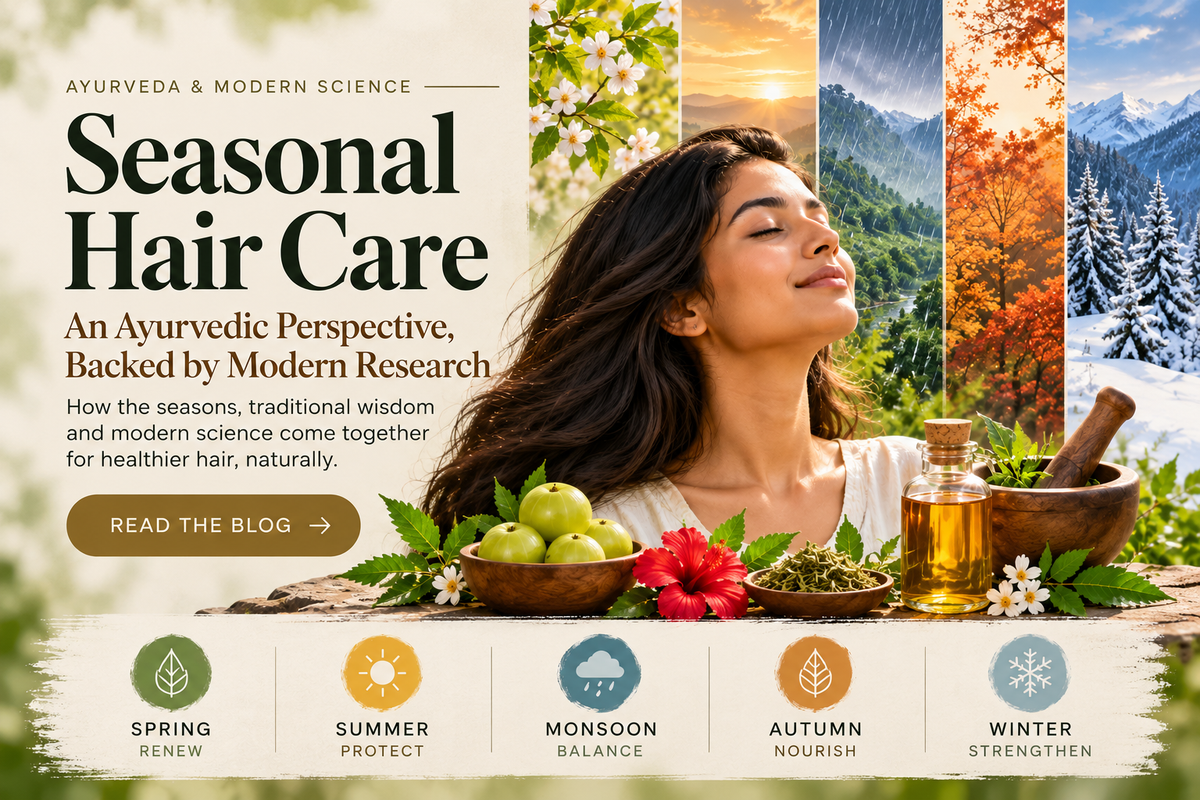
A passage in the Ashtanga Hridayam is commonly interpreted as: those who follow the seasonal regimen are rarely touched by disease.
It is a strong claim. But it rests on a premise that is difficult to argue with: the body is not separate from its environment. It responds to light, temperature, humidity, and the rhythm of the seasons. Health, in the Ayurvedic view, is not a fixed state to be achieved and maintained. It is an ongoing, active relationship between the person and the world they inhabit.
Hair, in this framework, is one of the most visible records of that relationship.
This piece is about what the Ayurvedic tradition actually says about seasonal hair care, not as a claim that ancient texts have been proven by modern science, but as a framework that has its own coherence, its own practical value, and an interesting partial overlap with what research has since documented independently.
The two are worth keeping distinct. Ayurveda and modern hair science are different frameworks. Where they point in similar directions, that is genuinely interesting. Where they differ, both deserve to be heard on their own terms.
Ritucharya: The Seasonal Regimen
Ritucharya, from Ritu (season) and Charya (conduct or regimen), is the Ayurvedic science of living in alignment with seasonal change. It is documented across multiple classical texts, including the Charaka Samhita and the Ashtanga Hridayam, and represents an early and systematic approach to adapting diet and lifestyle to seasonal change.
The Indian Ayurvedic calendar recognises six seasons: Shishira (late winter), Vasanta (spring), Grishma (summer), Varsha (monsoon), Sharad (autumn), and Hemanta (early winter). The classical framework divides the year into six seasons, traditionally understood as roughly two months each, and each has a characteristic dosha profile, a pattern of imbalance the season tends to create in the body, which the season's regimen is designed to address.
The practical application of Ritucharya for hair centres on Murdha Taila, the application of medicated oil to the head. This practice appears consistently across the classical literature as a seasonal recommendation, though the specific herbs, quantities, and methods recommended vary across texts and traditions.
It is important to be honest here about what we know and what we do not. The classical texts are vast, varied, and have been interpreted and reinterpreted across centuries. Not every claim made in the name of Ayurveda traces back to a primary classical source. Where the seasonal guidance below draws from classical texts, that is stated. Where it reflects traditional practice or modern Ayurvedic interpretation, that is also stated.
The Ayurvedic Understanding of Each Season
Varsha: Monsoon
The Charaka Samhita and Ashtanga Hridayam describe Varsha as a season of diminished bodily strength and vitiated digestion. Vata, the dosha associated with dryness, movement, and instability, is described as aggravated through the summer months and made erratic by the rains. Pitta begins to accumulate but has not yet fully expressed.
For the scalp and hair, the classical understanding of Varsha maps practically onto a season of increased vulnerability. The scalp is described as requiring protective and nourishing treatment, specifically, lighter oil application with herbs suited to the damp-heat environment, and more frequent cleansing than other seasons.
Neem (Azadirachta indica) appears consistently in classical Ayurvedic references to scalp conditions associated with imbalance. It is one of the most extensively studied Ayurvedic herbs in modern research; laboratory studies have shown antifungal activity against various organisms, including dermatophytes. It is worth noting clearly that laboratory antifungal activity does not automatically translate into clinical treatment of scalp conditions when an herb is applied topically; the evidence base for Neem in topical scalp care is promising but not conclusive at the clinical level.
Bhringraj (Eclipta alba) is described in classical texts as kesharanjana, that which promotes hair health and colouring. It is among the most consistently cited herbs in Ayurvedic hair formulations. Modern preclinical research has shown hair-growth-promoting activity in animal studies. Robust human clinical evidence for topical Bhringraj specifically remains limited; this is worth stating honestly rather than presenting it as established.
Sharad: Autumn
Sharad is described in classical Ayurvedic texts as the season when Pitta, accumulated through the heat of summer, begins to express itself outwardly. The Ashtanga Hridayam describes Sharad as a period requiring cooling, calming, and Pitta-reducing practices.
For hair and scalp, this is reflected in the classical recommendation for cooling herbs and gentler treatments during this period. The scalp in Sharad, from an Ayurvedic perspective, is reactive and sensitive, and the texts caution against stimulating or heating practices that would aggravate the already elevated Pitta.
Amla (Phyllanthus emblica / Indian Gooseberry) is the herb most consistently associated with Pitta-cooling properties in classical references. It appears in an enormous range of Ayurvedic formulations, including those for hair. Amla is among the better-studied Ayurvedic herbs in modern research; it is exceptionally rich in Vitamin C and contains several other antioxidant compounds. A randomised controlled trial involving 52 women found that oral Amla supplementation improved the ratio of hairs in the growth phase compared to the resting phase in women with female androgenetic alopecia. This is meaningful and worth noting, though it is evidence for an oral intervention in a specific condition.
Hemanta and Shishira: Winter
The Ashtanga Hridayam is explicit about winter being the season of greatest bodily strength and the period most suited to nourishing and building practices. Abhyanga, full-body oleation, is prescribed daily in Hemanta. The emphasis on oil and warmth during this season is consistent across classical sources.
For hair, the classical understanding of winter aligns with a season of restoration after the stress of the preceding months. The texts recommend generous head oiling during Hemanta; sesame oil is among the classical recommendations, described as warming and penetrating in Ayurvedic terms.
On the modern evidence for sesame oil specifically: research on hair oil penetration has established that oils with smaller molecular structures and greater affinity for hair proteins penetrate the hair shaft more effectively than others. The best-evidenced oil for shaft penetration and reduction of protein loss in the hair science literature is coconut oil, not sesame oil. Sesame oil has long traditional use and contains beneficial compounds, but claims about its specific penetration properties would need formulation-specific evidence to be made confidently.
What can be said with reasonable confidence is that pre-shampoo oiling can reduce friction and, for certain oils, reduce protein loss from the hair fiber during washing. This is a more limited claim than "nourishing the follicle," but it is a defensible and genuinely useful one.
Vasanta: Spring
Vasanta is described in Ayurvedic texts as the season of transition; Kapha accumulated through winter begins to liquefy and move. The classical literature describes Ritu Sandhi, the 14-day transition between seasons, as a period requiring gradual rather than abrupt shifts in regimen to prevent what the texts call "habituation diseases", conditions arising from an abrupt change in the body's accustomed environment.
Applied to hair care, the traditional principle of gradual transition has a practical logic independent of whether one accepts the dosha framework entirely. A scalp that has been receiving heavy winter oiling does not need to be abruptly stripped. A gradual reduction in oiling frequency and duration through spring allows the scalp's own sebum production to recalibrate without the stress of sudden withdrawal.
This is traditional reasoning. The modern evidence for this specific mechanism is not established. But the underlying logic- gradual change is less disruptive than sudden change - is reasonable.
Grishma: Summer
Grishma is the season of peak Pitta and heat. The classical texts describe this as a period requiring protection and cooling. For hair, the emphasis in traditional practice has always been on shielding the scalp and hair from the effects of sustained heat, which in the modern context includes UV radiation alongside direct heat.
Amla, again, is the classically recommended protective herb for summer. Its antioxidant properties are well-documented in the research literature. Whether topically applied Amla in an oil formulation provides meaningful UV protection to the hair shaft specifically is a different question, one that would require formulation-specific testing to answer confidently. The general antioxidant activity of Amla compounds is established; the topical UV-protection claim for a specific product would need its own evidence.
What the Tradition Gets Right: Honestly
The Ayurvedic seasonal framework was not built through randomised controlled trials. It was built through centuries of careful observation of patterns, what happens to bodies and hair and skin when seasons shift, and what interventions seemed to help.
Some of what it observed has since been independently confirmed. Modern research has documented seasonal variation in human hair cycling, the general principle that more hairs enter the shedding phase at certain times of year. This aligns with the Ayurvedic understanding of seasonal vulnerability without being the same as it.
Some of what it recommended has since found partial support in evidence. Pre-shampoo oiling to protect the hair fiber during washing. Cleansing that does not strip the scalp's natural balance. The value of scalp massage for circulation. These are practices with some evidence base in modern cosmetic science.
Some of it remains in the domain of traditional knowledge: the dosha framework, the specific seasonal herb emphases, the concept of Pitta accumulation and release. These are Ayurvedic explanatory frameworks. They are not the same as modern physiological mechanisms, even where they describe similar patterns. Presenting them as equivalent would be inaccurate in both directions; it would misrepresent the tradition and overstate the modern evidence.
What the framework offers, taken on its own terms, is something genuinely useful: a structured seasonal awareness. The idea that hair care should be responsive to the environment, lighter in monsoon, more nourishing in winter, protective in summer- has practical value regardless of whether one accepts the full dosha explanation for why.
The Herbs: What the Evidence Actually Says
Because herb claims are where the gap between traditional use and modern evidence is most frequently misrepresented, it is worth being specific.
Bhringraj (Eclipta alba): Traditional use in Ayurvedic hair preparations is well-documented. Preclinical studies (animal models) have shown hair-growth-promoting activity. Human clinical evidence for topical use is limited.
Amla (Phyllanthus emblica): Rich in Vitamin C and antioxidant compounds. One randomised controlled trial found oral supplementation improved hair cycle metrics in female androgenetic alopecia. Topical evidence is less established than oral evidence.
Neem (Azadirachta indica): Antifungal activity demonstrated in laboratory studies against various organisms. Translation from in-vitro antifungal activity to clinical scalp benefit in topical application has not been definitively established.
Jatamansi (Nardostachys jatamansi): Preclinical studies have shown hair-growth-related activity. Human clinical evidence is limited.
Mulethi (Glycyrrhiza glabra / Liquorice Root): Anti-inflammatory properties documented in research. Topical scalp applications have been studied in some contexts. The evidence base is developing.
Shikakai (Acacia concinna): Long traditional use as a natural hair cleanser. Contains saponins. Research on its specific scalp mechanisms is limited, but its use as a gentle cleanser has traditional grounding.
Shankhpushpi (Convolvulus pluricaulis): An important Ayurvedic herb, though it is worth noting that "Shankhpushpi" is botanically ambiguous; multiple plant species have historically been associated with this name in different regional traditions. Any product using Shankhpushpi should specify the botanical name and species used.
Sesame Oil (Sesamum indicum): Traditional Ayurvedic base for hair oils, with warming properties in the dosha framework. Contains antioxidant compounds (sesamin, sesamolin). The specific hair-shaft penetration evidence is less established than for coconut oil.
The honest summary: these are herbs with genuine traditional histories and, for several of them, genuine preclinical interest. The evidence base is uneven and ongoing. Traditional use is not the same as clinical proof, and preclinical findings are not the same as human outcomes. Both things can be true at once, these herbs have earned their place in traditional formulations and the modern evidence is still developing.
What This Means in Practice: The Vanyam Approach
Vanyam's Hair Revival Oil is built around ten of these traditional herbs: Bhringraj, Amla, Jatamansi, Shikakai, Shankhpushpi, Mehandi, Mulethi, Neem, Bael, and Sesame Oil as the base, in doses that reflect traditional formulation practice, not token inclusions.
We are not going to tell you that this oil will regrow your hair, reverse hair loss, or treat any clinical condition. The evidence does not support those claims for topical herbal oils, and making them would be dishonest.
What we can say honestly:
The herbs in this oil have documented traditional use in Ayurvedic hair care across centuries of practice. Several have preclinical research interest. Pre-shampoo oiling as a practice has evidence for protecting the hair fiber during washing, and scalp massage has been studied for its effects on circulation and follicle stimulation.
The oil is formulated without mineral oil, parabens, or sulphates, which means what is in the bottle is what the label says, without fillers that dilute the herbs or surfactants that strip the scalp.
Used consistently as a pre-wash treatment, applied to the scalp, massaged in, left for at least an hour, and washed out with a gentle sulphate-free shampoo, it is the Ayurvedic practice of Murdha Taila brought into a modern formulation. The tradition behind it is real. The herbs in it are traditional. The outcomes depend on the individual, are not guaranteed, and will not replace medical treatment for clinical conditions.
The Restorative Hair Serum is the leave-in companion, applied to towel-dried hair after washing, before going out. Where the oil works at the scalp before washing, the serum works at the shaft after. It provides the conditioning and protective layer that the oil, once washed out, can no longer provide.
The Hair Vitality Supplement contains Bhringraj, Amla, Brahmi, and Ashwagandha. Hair is systemic; it grows from follicles that are part of the body, nourished by what the body absorbs. Nutritional support for hair has evidence in the context of specific deficiencies. These herbs have traditional use for internal wellness and some preclinical interest. The supplement is not a treatment for hair loss. It is a nutritional support product built around traditional formulations.
The Natural Hair Revitalizing Shampoo is sulphate-free. The reason this matters practically is that sulphate surfactants, while effective at cleansing, are alkaline and strip the scalp's natural moisture barrier. A gentler cleanser that removes oil and buildup without disrupting the scalp's pH is not a luxury. It is what makes the rest of the routine sustainable without causing net damage.
The Complete Hair Care Ritual Kit brings all five products together- oil, shampoo, conditioner, serum, supplement- as the full seasonal system, usable year-round with adjustments in frequency and emphasis as the seasons shift.
A Final Note
The Ayurvedic tradition and modern hair science are both incomplete, each in their own way. Ayurveda has centuries of observational wisdom and a coherent seasonal framework but limited modern clinical validation. Modern hair science has rigorous methodology but a relatively short history of studying the specific herbs and practices that traditional systems have used for millennia.
The honest position, which is also the most useful one, is to draw from both without conflating them. To say what the tradition recommends and why. To say what modern research has and has not confirmed. To use products whose ingredients have genuine traditional grounding and developing scientific interest, without overclaiming what they will do.
That is the standard Vanyam holds itself to. When the evidence catches up, we will say so. When it doesn't yet, we will say that too.
Explore Vanyam's full hair care range at vanyam.com


